
The Story of the Golden Buddha & Returning to Yourself
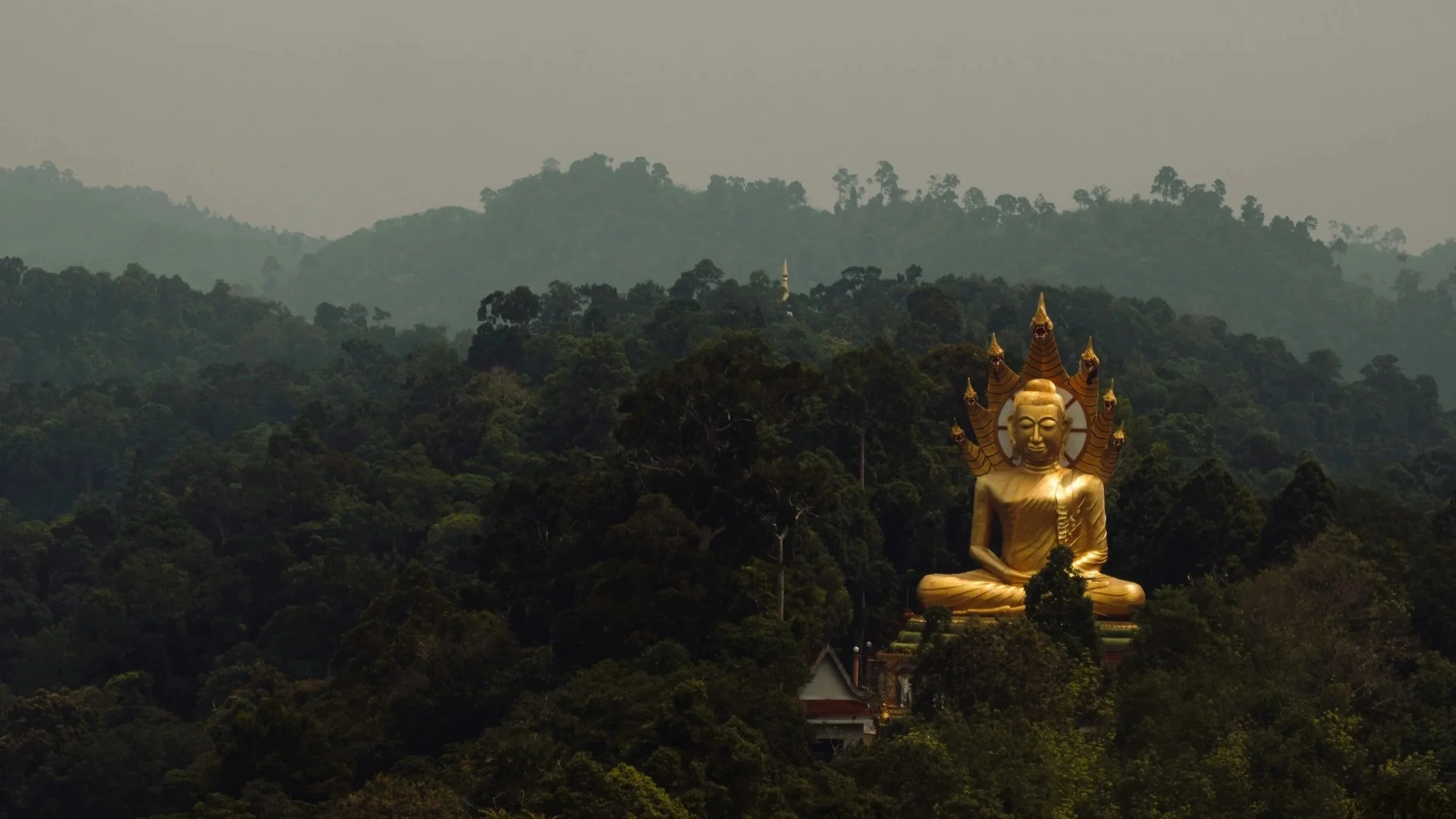
Below is a snippet from a document called "The Story of the Golden Buddha and Returning to Yourself," taken from the Mindful Travel Toolkit and Guide.
The Story of the Golden Buddha
There is a beautiful story told about the Golden Buddha of Thailand. Centuries ago, as invading armies threatened the ancient Kingdom of Siam, monks feared that their treasured solid gold Buddha would be stolen or destroyed. To protect it, they carefully covered the statue with layers of plaster and clay until it appeared to be nothing more than an ordinary stone figure. The disguise worked. The armies passed it by, never realizing what lay beneath.
As the years turned into decades, and decades into centuries, the monks who knew the statue's secret passed away. Eventually, the story itself was forgotten. Generations came and went believing the weathered plaster statue was exactly what it appeared to be.
One version of the story tells of a young monk who, centuries later, was sitting quietly beside the old statue after a rainstorm. As he leaned against it, a small piece of the outer layer broke away. Beneath the cracked plaster, he noticed something catching the light.
Curious, he gently chipped away another piece. Then another. And another. Slowly, the truth began to emerge. Hidden beneath the ordinary exterior was one of the world's largest solid gold Buddha statues. It had never stopped being gold. It had never lost its beauty or its value. For generations, it had simply been hidden beneath layers that had accumulated over time.
Whether every detail of the story happened exactly this way is almost beside the point. Like many enduring stories, its greatest value lies not in its historical precision, but in the truth it helps us see.
Perhaps we are all a little like the Golden Buddha. Not because we are perfect, but because life has a way of covering the best parts of ourselves with layer upon layer of responsibility, expectation, routine, distraction, and stress.
The question, then, isn't whether there is gold beneath the surface. The question is how we uncover it.
Travel, as it turns out, may be one of the most powerful tools we have for finding out.
Returning to Yourself
Travel is often described as an opportunity to discover the world. It allows us to experience unfamiliar cultures, remarkable landscapes, different histories, new flavors, and perspectives that expand our understanding of the places we visit. All of that is true. But perhaps travel offers something even more meaningful. Perhaps, at its best, it gives us the opportunity to return to ourselves.
As children, many of us move through the world with an effortless sense of curiosity. We ask questions without worrying whether they're good questions. We notice things adults overlook. We laugh easily, play freely, and become completely absorbed in the moment we're experiencing. We aren't thinking about deadlines, inboxes, obligations, or the hundred things waiting for us tomorrow. We're simply present.
As life unfolds, however, that begins to change. Careers, families, responsibilities, routines, and expectations gradually fill our days. None of these things are inherently bad – in fact, many of them are among life's greatest privileges – but they leave little room for stillness, wonder, creativity, and reflection. Over time, we become incredibly capable at managing life while slowly losing touch with the qualities that once came so naturally.
Like the Golden Buddha, the gold hasn't disappeared. It's simply become hidden beneath the layers.
One of the greatest gifts of travel is that it creates the space to uncover those qualities again. That doesn't happen automatically, nor is it determined by how far we travel or how much we spend. It depends far more on how we choose to approach the journey.
Once you arrive, there is an opportunity to begin letting go.
The work waiting back home, the endless notifications, the running to-do list, and the pressures of everyday life will still be there when the journey is over. For now, give yourself permission to be exactly where you are. Be present with the place you've come to experience, the people you're traveling with, and the moments unfolding around you. The more fully you immerse yourself in the journey, the more space you create for something unexpected to emerge.
Travel with curiosity. Listen more than you speak. Ask questions without assuming you already know the answers. Slow down enough to notice the details that most people rush past. Wander without feeling the need to accomplish something. Try unfamiliar foods. Strike up conversations with people whose lives are different from your own. Resist the urge to experience every moment through a camera lens before you've allowed yourself to experience it firsthand.
The more present you become, the more the layers begin to fall away. Sometimes it's gradual. Sometimes it happens almost overnight. You realize you've gone an entire afternoon without thinking about work. You find yourself laughing more easily. Conversations become deeper because they're no longer about schedules and logistics. You become more patient, more curious, more creative, and more open to the people and places around you.
Then, often without realizing it, a different thought begins to emerge.
I like who I am when I'm here.
It's tempting to believe that travel has transformed you. But maybe travel isn't about becoming someone new. Maybe it's about remembering who you've been all along. The person you're experiencing on this journey isn't a new version of yourself. It's the version that has been patiently waiting beneath the layers of expectation, routine, and distraction. Travel didn't create that person. It simply created the space for them to reemerge.
Not transformation, but a return to self.
That’s why the journey doesn't really end when you return home. In many ways, that's where the real practice begins. The challenge isn't remembering the trip. It's protecting the version of yourself you rediscovered from gradually being buried again beneath the demands of everyday life.
For every traveler, that practice will look different. It may mean spending more time outdoors, developing a meditation or journaling practice, putting the phone away during dinner, reconnecting with an old hobby, learning something new simply for the joy of learning, or creating more space for meaningful conversations, movement, creativity, and rest. The specific practice matters less than the intention behind it. What matters is making conscious choices that help preserve the qualities that made you feel most alive while you were away.
Life will always add new layers. There will always be responsibilities, obligations, and distractions competing for our attention. The goal isn't to eliminate them. The goal is simply to notice when those layers begin covering the parts of ourselves we worked so hard to rediscover.
Because perhaps the greatest gift travel has to offer isn't that it changes who we are. It's that it reminds us of who we've been all along … and challenges us to live in a way that keeps that person from becoming buried again.