
Destination: Slovenia – On Belonging
From the Substack Mindful Travel Confessions by Camila Castro
Travel has always been more than sightseeing to me. More than checking places off a list, more than collecting views or passport stamps. It’s been a teacher, a mirror, and a passion. Over time, as I cultivated a more mindful mindset, travel remained all those things, but it also shifted into something greater. It became the kind of experience that asked for something more from me — more presence, more openness, more willingness to be received. Above all, it encouraged a deeper connection… not just to a place but, more significantly, to the people who call it home.
Slovenia gave me that kind of travel. Again and again and again.
It started with Domen, part of the local team that works with Explorer X — the travel design company behind my Destination: Unknown adventure. On paper, he was my guide, but in practice, he was something closer to a travel companion and, by the end of fourteen days, a friend. He knows Slovenia the way only someone who grew up loving a place can know it — not just its landscapes and landmarks but its people, its rhythms, its hidden gems. On our very first hike together, he stopped at a mountain hut and said, simply: “Trust me, try the jota.”
I had no idea then that a humble stew of sauerkraut and beans would soon become one of my all-time favorite dishes. He shared all of this with me with a generosity and warmth of spirit that set the tone for everything that followed.
“I’ve been asked, since returning, what made Slovenia different. And the honest answer is: The people.”
Branka's Table
The afternoon spent at Branka’s came early in the trip… early enough that I hadn’t yet learned what to expect from Slovenia. Which meant it hit me the way some of the best things do: completely off guard.
Branka lives in the countryside, in the kind of home that makes you understand immediately why someone would never want to leave. Her garden was in full spring mode — trees blooming everywhere and the most beautiful produce I have ever seen, freshly harvested and laid out like a still life on the kitchen counter: vivid greens, bright reds, deep purples.
We helped prepare the meal first, though “helped” is a generous term since most of what we did was admire the ingredients and stay out of the way of someone who clearly knew exactly what she was doing. Simple, seasonal food that tasted like the ground it came from.
We sat down for lunch, joined by Tjaša — a local artisan who would later teach us to make beeswax candles — and what followed was one of those afternoons that unfolds at exactly the right pace, the kind you don’t want to end. We ate and talked and laughed. They were curious about my life; I was curious about theirs. There was an ease to it that I hadn’t expected. A familiarity that made no logical sense, given that we had met only hours before.
It reminded me, powerfully, of my grandmother’s house in Ecuador. The same quality of welcome and the same feeling of a table that expands to include whoever arrives at it. The sense that food is not just sustenance but an act of genuine care, offered without ceremony and received with gratitude.
While Branka disappeared into the kitchen to finish dessert — a merengue pie made from her own recipe that turned out to be one of the best things I have ever tasted, and somehow, miraculously, not too sweet — Tjaša set up the candle-making workshop at the kitchen table. Working with raw beeswax, learning this ancient craft from someone who clearly loved it, was the kind of afternoon that feels almost too good to be real. Domen, for his part, threw himself into the candle-making next to me and produced what was, objectively, the best candle of the bunch.
As we drove away from Branka’s house, four of my handmade candles carefully wrapped in my bag, I felt, inexplicably, like I had spent the day with old friends.
Liza’s Workshop
The wet felting was on a different day, in a different town; a workshop with a soft-spoken artist named Liza.
I knew nothing about wet felting before I walked in, wasn’t even entirely sure what it was, but within minutes of sitting down at Liza’s table, hands soaped and working wool into shape, I immediately understood why people do this. And why Liza, and others like her, have lovingly kept this craft alive through generations.
It was meditative and playful in equal measure. The kind of activity that quiets the mind without boring it, and that asks for your full attention without demanding anything beyond your presence. I could see how it would be very easy to get into a flow state doing this. Liza was a patient, gentle teacher. Her calm was contagious and her lighthearted banter gave the entire experience an almost childlike energy.
After a couple of hours, I ended up with a trivet — a small, imperfect, entirely charming trivet that I brought home as a souvenir for my parents — and I could have stayed for hours trying to make everything from slippers to earrings. Domen, meanwhile, produced what can only be described as a work of art, making me slightly envious.
There is something about learning a craft from the hands that have always made it, in a place where it is deeply rooted, that feels like receiving a small piece of cultural inheritance. Like being trusted with something special. Like being let in.
I left already thinking about how to take up wet felting back at home. This is one of my favorite parts of intentional travel… when a new activity you encounter comes home with you and becomes a part of your regular life.
Jožica’s House
To get to Jožica’s house, you have to know about it.
It doesn’t appear on tourist maps or on the usual booking platforms. It sits in a tiny village on a mountain near Nova Gorica — the kind of place you would drive through without stopping unless someone who knows tells you to stop. You have to call ahead, and you have to know to call.
Domen knew.
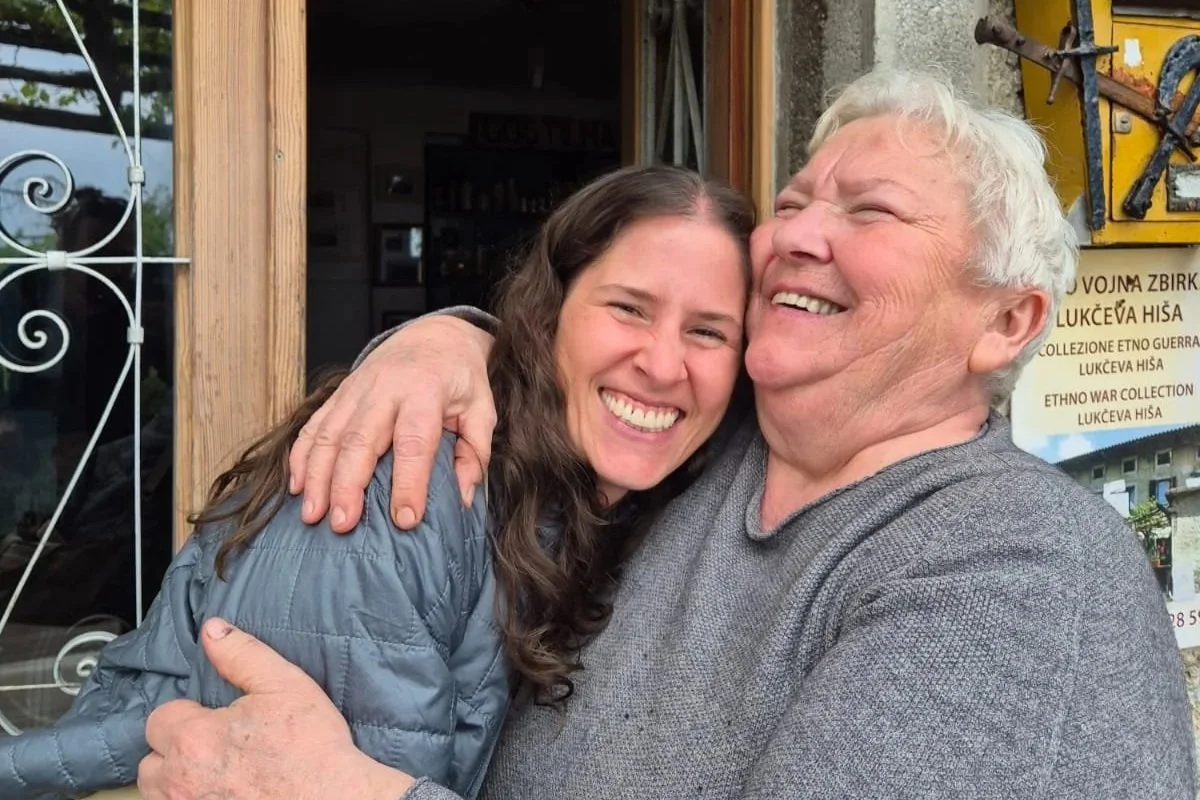
We pulled up to a traditional Slovenian house, and Jožica was waiting. She greeted Domen like an old friend and welcomed me with the same easy warmth, as if I had simply arrived a little later than expected.
We stepped through the door and into what felt like another era.
Her home is an ethnographic monument, though that designation does nothing to capture what it actually feels like to be inside it. The stone entrance hall stopped me immediately. The walls and shelves were crammed with an eclectic collection of family photographs, Yugoslavian-era posters, dishware, trinkets of every kind, and bottles of local spirit — the accumulated texture of a full life. But the heart of her home is very clearly the kitchen. Jožica still cooks on a massive 19th-century stone hearth — what was once called a “black kitchen” — and in the adjacent wood-burning oven. Something was simmering over the open flame when we visited.
She fed us. Of course, she fed us.
A beautiful, generous spread: risotto, frtalja (a rustic frittata of sorts), a salad of beans and egg that I adored immediately and could have eaten every single day, and a Slovenian strudel for dessert. All of it homemade for us, by her, just because we had stopped by for a visit. While we ate, she chatted and Domen translated, sharing bits about her life and asking about mine. Again, I was hit by that feeling of belonging somewhere I had never been before.
After lunch, she took us up to the third floor to see her collection of wartime artifacts that she had spent 30 to 40 years assembling: documents, letters, uniforms, weapons — all objects from both World Wars found in the surrounding hills. Everything carefully placed and tenderly preserved. Standing in that room, holding the weight of that history, I felt something I can only describe as the particular privilege of being let in … not just into a home, but into someone’s life. Into a story that would have continued without me and will continue after me, but that paused, for an afternoon, to include me.
I’ve been asked, since returning, what made Slovenia different. What made it more than just another beautiful European country with mountains and lakes and good food?
And the honest answer is: The people.
Not in the abstract, friendly-locals way that can be found in most places. But in the specific, concrete way that makes hospitality feel like it comes from the heart. Branka, whose table felt like family right away. Tjaša, who taught me something with her hands. Liza, who gave me an afternoon of stillness and a new hobby to pursue. And Jožica, who preserved an entire way of life and shared it with us over lunch, as if welcoming strangers into her home were the most natural thing in the world.
And Domen, who knew where to find all of them.
Food was part of it, too. I ate jota almost every day, even going out of my way for one last bowl on my final evening in Ljubljana. It became my comfort food and my most reliable reminder that I was exactly where I was supposed to be. I’m still thinking about finding a simple recipe and trying to make it at home.
None of these moments were ones I could have found on my own. They existed because someone else was holding the map — and because that someone knew that the most meaningful experiences in any place are rarely the ones you can book online. They’re the ones that require trust, local knowledge, and maybe a phone call made by someone who already knows to call.
What does it mean to belong somewhere you’ve never been?
I think it means being received. Being welcomed in. But, more than anything, being seen, briefly and genuinely, by someone who had no obligation to see you.
Slovenia did that for me. More times than I can count.
With love + curiosity,
Camila
About Mindful Travel Confessions by Camila Castro on Substack
For seekers bridging who they've been with who they're becoming, one journey at a time. Writer & Mindful Travel Coach sharing honest stories from the road, frameworks for intentional travel, and updates from my creative journey.